



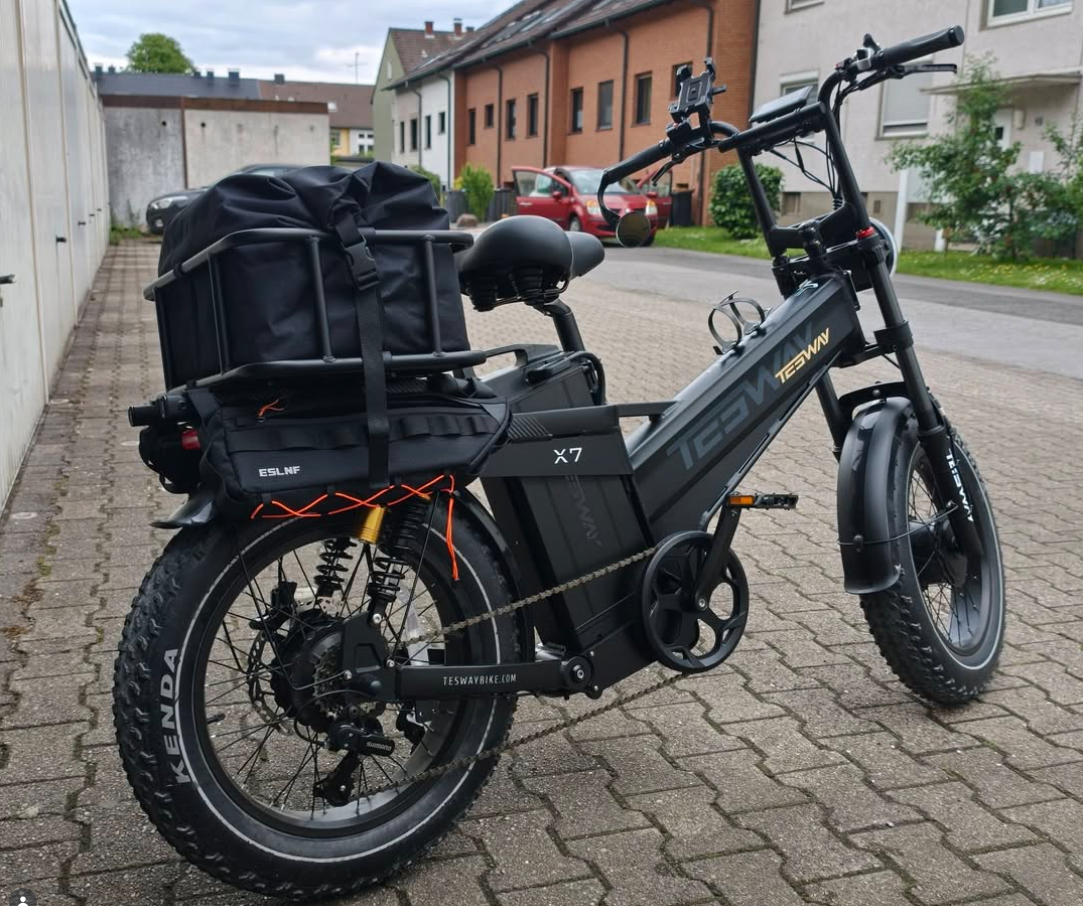
- by Tesway ElectricBike
Fast Electric Bike Buying Guide: Speed, Power and Key Features
- by Tesway ElectricBike
When shopping for a fast electric bike, it is easy to focus on the biggest number you can find. A 1,000W motor sounds powerful, while a 2,000W or 4,000W peak output sounds even more impressive. But motor power alone does not tell you how fast an electric bike will actually go.
This guide compares the top speeds of electric bikes with different motor power ratings, explores how batteries, controllers, torque and wheel configurations affect performance, and explains what to look for when choosing a fast electric bike.
Electric bike speeds range from 15.5mph on standard UK EAPCs to 50mph or more on specialist high powered models.
In Great Britain, a standard electrically assisted pedal cycle (EAPC) has a maximum continuous rated motor power of 250W, with electrical assistance cutting out at 15.5mph. The rider can still pedal faster, but the motor must stop providing assistance above that speed.
High powered electric bikes occupy a different performance category. Models advertised at 30mph, 40mph or more offer substantially higher performance, although their legal classification and permitted riding locations are different from those of a standard EAPC.
At the top end, the fastest electric bikes in the UK include specialist electric dirt bikes and high output pedal equipped models, with manufacturer claimed speeds reaching 70mph.
Motor wattage is a useful starting point when comparing fast electric bikes. Higher powered motors generally offer stronger acceleration, more pulling power and the ability to sustain higher speeds.
Here is a comparison of commonly advertised top speeds across different motor power categories.
| Motor Power | Advertised Top Speed (Approx.) | Speed (km/h) |
|---|---|---|
| 250W | 15.5 mph* | 25 km/h |
| 500W | 20–28 mph | 32–45 km/h |
| 750W | 20–28 mph | 32–45 km/h |
| 1,000W | 28–33 mph | 45–53 km/h |
| 1,500W | 34–35 mph+ | 55–56 km/h+ |
| 2,000W | 28–40 mph | 45–64 km/h |
| 2,500W | Around 40 mph | Around 64 km/h |
| 3,000W | 40–50 mph | 64–80 km/h |
| 4,000W | 40–55 mph | 64–88 km/h |
| 5,000W | 50–59 mph | 80–95 km/h |
| 6,000W | 45–60 mph | 72–97 km/h |
The 15.5mph figure for 250W refers to the UK EAPC motor assistance cut-off, not the bicycle's physical maximum speed.
These are indicative manufacturer advertised speed ranges, not a direct conversion between watts and mph.
A 1,000W electric bike typically sits around the 28–33mph mark in this comparison, while a 2,000W model can reach approximately 40mph. At the higher end, 3,000W and 4,000W systems are advertised at speeds of 40–55mph.
Battery voltage and controller settings become particularly important when judging how fast a 2,000W electric bike can go, as they influence the motor's rotational speed and available output.
At 5,000W, the difference between a heavy fat tyre build and a performance focused setup becomes more noticeable. Heavy builds may sit around 40–50mph, while performance focused configurations can reach 50–60mph. These 5,000W electric bike top speeds also show why battery voltage and overall bike design matter alongside motor output.
Power also changes how the bike gets up to speed. A stronger motor can pull away more forcefully, climb steeper gradients and hold its pace more comfortably when carrying additional weight.
The motor gets most of the attention, but the battery and controller have just as much influence over the way an electric bike performs. Torque and wheel configuration then shape how that power reaches the ground.
Motor power is measured in watts (W). It describes the rate at which the motor delivers mechanical power.
A higher powered motor has more capacity for acceleration and sustained output. On a flat road, that can mean getting up to speed more quickly. On a steep country lane, it means having more power available to keep the bike moving rather than watching its speed drop as the gradient steepens.
There are two motor ratings worth looking at: continuous rated power and peak power.
| Specification | Continuous Rated Power | Peak Power |
|---|---|---|
| Meaning | Output the motor is designed to sustain | Highest short term output |
| Main benefit | Sustained performance | Stronger bursts of acceleration |
| Typical riding situation | Maintaining power on a long climb | Pulling away or tackling a short, steep section |
| What it tells you | Sustained motor capability | Maximum temporary output |
The difference becomes clear when looking at a dual motor system.
The TESWAY X9 Ultra, for example, has two motors rated at 1,200W each, giving a combined rated output of 2,400W. Each motor can reach 2,000W peak power, giving the system a combined peak output of 4,000W.
That extra peak output gives the bike more power available during demanding bursts of acceleration. It is important to distinguish this from its continuous rated output, though. A 4,000W peak rating does not mean the motors deliver 4,000W throughout an entire ride.
Battery voltage plays a major role in how quickly an electric motor can rotate.
Most performance electric bikes use 48V, 52V or 60V battery systems. Higher voltage can support a higher motor RPM when the motor windings and controller are designed for that voltage.
Think of it this way: voltage helps determine how fast the motor can spin, while current influences how much torque it can produce under load.
Battery capacity is a separate measurement. It tells you how much energy is stored and is usually expressed in amp-hours (Ah) or watt-hours (Wh).
The following table shows how much energy different battery systems store when they have the same 20Ah capacity.
| Battery Voltage | Capacity | Energy Storage |
|---|---|---|
| 36V | 20Ah | 720Wh |
| 48V | 20Ah | 960Wh |
| 52V | 20Ah | 1,040Wh |
| 60V | 20Ah | 1,200Wh |
The calculation is straightforward:
Watt-hours (Wh) = Voltage (V) × Amp-hours (Ah)
A higher Wh figure means more stored energy for the ride. This is particularly useful on longer routes, where frequent climbs and higher assistance levels can quickly drain a smaller battery.
For speed, pay attention to voltage and motor compatibility. For range, compare total watt-hours.
The motor controller regulates the electrical power flowing from the battery to the motor. It controls how much current reaches the motor and manages how power is delivered as the rider accelerates.
Two settings matter most:
Current limit (A): Controls the electrical current available to the motor. More available current can support stronger torque and acceleration.
Speed limit: Sets the maximum speed at which the motor provides assistance.
This is why the controller has such an important effect on performance. A powerful motor cannot deliver its full potential if the controller restricts the available current or limits motor assistance at a particular speed.
The controller must also match the battery and motor. A 60V battery, for example, needs a compatible controller and motor system designed to operate at that voltage.
Motor power and torque describe two different things.
Power, measured in watts, describes the rate of energy delivery. Torque, measured in Newton metres (Nm), describes the turning force produced by the motor.
You feel torque most clearly when pulling away from a standstill, climbing a steep hill or carrying a heavy load.
Picture a steep country lane with a sharp gradient. A high torque motor can deliver a stronger push at the wheel, helping the bike get moving without feeling sluggish. It is particularly useful when the bike is heavily loaded or the climb gets steeper.
Dual motor electric bikes take this a step further by distributing propulsion across the front and rear wheels. This can improve traction on loose gravel, muddy tracks and other surfaces where a single driven wheel may struggle to find grip.
However, torque is not the same as top speed. A bike with 200Nm of torque can accelerate more forcefully than one with 100Nm without necessarily reaching a higher maximum speed.
For riders who regularly tackle steep routes or carry additional weight, torque deserves as much attention as the headline wattage.
A folding e-bike usually has 20 inch wheels, while performance mountain e-bikes commonly use 27.5 or 29 inch wheels. High powered moped style and off road electric bikes often take a different approach, using much wider 20 x 4.0 inch or 26 x 4.0 inch fat tyres.
Both wheel diameter and tyre width affect how the bike handles, rolls over obstacles and performs on different surfaces.
Here are the common wheel and tyre combinations found across electric bikes.
| Wheel and Tyre Size | Typical E-bike Type | Riding Characteristics |
|---|---|---|
| 20 x 2.0–2.4 inch | Folding and urban e-bikes | Compact and easy to manoeuvre |
| 20 x 3.0–4.0 inch | Moped style and fat tyre e-bikes | Wide tyres provide cushioning and grip |
| 26 x 1.75–2.5 inch | Commuter and mountain e-bikes | Balanced handling and rolling efficiency |
| 26 x 3.0–4.0 inch | Fat tyre and off road electric bikes | Greater tyre volume for gravel and rough terrain |
| 27.5 x 2.0–2.6 inch | Performance mountain e-bikes | Balance of agility, grip and rolling performance |
| 29 x 2.2–2.6 inch | Trail and mountain e-bikes | Rolls over obstacles more easily and maintains momentum |
| 700c x 35–50mm | Road, gravel and commuter e-bikes | Efficient rolling on paved roads |
Do Fast Electric Bikes Use Fat Tyres?
Yes. Many high powered electric bikes use 20 x 4.0 inch or 26 x 4.0 inch fat tyres, particularly models designed for off road riding and mixed terrain.
TESWAY provides two good examples:
TESWAY X9 Ultra: Uses 26 x 4.0 inch Kenda fat tyres.
TESWAY X5 AWD and X7 AWD: Both use 20 x 4.0 inch Kenda fat tyres.
The difference is more than appearance. A 26 inch wheel has a larger diameter, helping it roll over potholes, rocks and uneven ground. A 20 inch wheel creates a more compact setup, while its wide 4 inch tyre provides plenty of air volume for cushioning and grip.
Not all fast electric bikes use fat tyres. Performance mountain e-bikes commonly use 27.5 or 29 inch wheels with narrower 2.2–2.6 inch tyres. These suit riders who prioritise rolling efficiency and responsive handling on established trails.
Does a Larger Wheel Make an Electric Bike Faster?
A larger wheel travels further with each rotation. At the same wheel RPM, a 29 inch wheel covers more ground per revolution than a 20 inch wheel.
Larger wheels also roll over potholes, roots and rocks more easily. This helps maintain momentum on rough country tracks and mountain trails.
Smaller 20 inch wheels create a compact setup and are easier to manoeuvre, which is why they are popular on folding and moped style electric bikes.
Do Wider Tyres Reduce Electric Bike Speed?
On smooth tarmac, wide fat tyres generally feel heavier and less responsive than narrower road tyres. Their weight and rolling resistance can make acceleration feel less immediate and use more battery energy.
The advantage becomes obvious when the surface gets rough.
A 4 inch fat tyre has a large air volume, allowing it to run at a lower suitable pressure and soak up bumps that would otherwise travel straight through the handlebars and saddle. On pothole filled roads, loose gravel and uneven tracks, the bike feels more planted and settled.
That extra cushioning is particularly useful on longer rides over broken surfaces. Narrower tyres are generally more efficient on smooth roads, while fat tyres offer greater comfort and versatility across rough terrain.
A powerful motor can pull an electric bike up to speed quickly, but the rider, road surface and weather all affect how much of that performance is available.
| Factor | Effect on Top Speed |
|---|---|
| Rider weight | More weight requires additional power, particularly when accelerating and climbing |
| Uphill gradients | The motor works harder against gravity, reducing climbing speed |
| Headwind | Greater air resistance makes it harder to maintain high speeds |
| Battery charge | Lower battery voltage can affect motor performance |
| Tyre pressure | Incorrect pressure increases rolling resistance or affects handling |
| Mechanical condition | Dragging brakes and drivetrain friction waste power |
Two situations make these differences particularly noticeable.
Riding uphill
A motor that feels powerful on a flat road can lose speed quickly on a steep climb. Gravity works against the bike, and the motor needs to produce more power to keep it moving. Additional torque helps the bike pull through the climb, particularly when carrying luggage or riding with a heavier load.
Riding into a headwind
Wind resistance becomes a much bigger obstacle as speed rises. At 30mph, an upright rider and bike have to push through considerably more air than they do at 15mph. Tucking in slightly can reduce the exposed frontal area and make it easier to hold speed.
Tyre pressure and mechanical condition matter too. Underinflated tyres, dragging brakes and a poorly lubricated drivetrain all make the motor work harder.
Yes. Higher speeds use more battery energy, mainly because aerodynamic drag increases rapidly as you ride faster.
A bike cruising at 20mph needs considerably more power to overcome air resistance than the same bike travelling at 15mph. Maintain that higher speed over a long ride and the battery will drain much faster.
The difference becomes even more noticeable when climbing hills or riding into a headwind. Both conditions demand additional motor output, leaving less stored energy for the rest of the journey.
Dual motor systems also use more energy when both motors are working hard. They provide stronger acceleration and additional traction, but that extra output comes directly from the battery.
Battery capacity matters here. Consider two TESWAY configurations:
60V 30Ah: Stores 1,800Wh of energy.
52V 60Ah: Stores 3,120Wh of energy.
The second battery stores considerably more energy, despite operating at a lower voltage. This is why Ah alone is not enough when comparing batteries. Total watt-hours give a much clearer picture of available energy.
For longer rides, a large battery provides more flexibility, particularly when the route includes steep climbs, loose surfaces or frequent bursts of acceleration.
A fast electric bike needs more than a powerful motor. The battery, controller, brakes, tyres and suspension all need to suit the way the bike will be ridden.
| Specification | What to Look For | Why It Matters |
|---|---|---|
| Motor power | Continuous rated and peak wattage | Indicates sustained output and short bursts of power |
| Battery voltage | 48V, 52V or 60V systems | Influences the motor's potential rotational speed |
| Battery capacity | Compare total Wh | Shows how much energy is available |
| Motor torque | Nm rating | Important for acceleration and hill climbing |
| Controller | Current and speed limits | Determines how power reaches the motor |
| Brakes | Hydraulic disc brakes and suitable rotors | Helps control a heavier, faster bike |
| Tyres | Width and tread suited to the riding surface | Affects grip, comfort and rolling efficiency |
| Suspension | Front or full suspension | Helps maintain control over uneven terrain |
Brakes deserve particular attention. A heavier electric bike carrying considerable speed needs a braking system that can shed that speed confidently. Hydraulic disc brakes, suitable rotor sizes and well maintained brake pads are important parts of the setup.
Suspension also changes how a fast bike behaves on rough ground. A good fork and rear suspension help keep the wheels tracking the surface instead of bouncing across potholes and loose stones.
The best setup is one that feels composed when accelerating, remains predictable through corners and can slow down confidently when the road demands it.
TESWAY offers three dual motor models worth comparing if you are interested in higher output electric bikes: the X9 Ultra, X5 AWD and X7 AWD.
Their motor configurations, battery capacities and wheel sizes give each model a distinct performance setup.
The TESWAY X9 Ultra uses a 60V dual motor system with a combined 4,000W peak output.
Its main specifications include:
| Specification | TESWAY X9 Ultra |
|---|---|
| Rated motor output | 1,200W x 2 |
| Combined peak power | 4,000W |
| Maximum torque | 240Nm |
| Battery | 60V 30Ah |
| Energy capacity | 1,800Wh |
| Manufacturer stated maximum speed | 43mph |
| Tyres | 26 x 4.0 inch Kenda fat tyres |
| Suspension | Full suspension |
The two motors provide 240Nm of combined maximum torque, giving the X9 Ultra substantial pulling power on steep inclines and loose surfaces.
Its 26 x 4.0 inch tyres also give it a different character from the smaller wheeled X5 AWD and X7 AWD. The larger wheels help roll over rough ground, while the wide tyres and full suspension take some of the sting out of rocky tracks and uneven country routes.
The manufacturer states a maximum speed of 43mph. Its 60V system, dual motor arrangement and 4,000W peak output form the basis of that high performance specification.
The TESWAY X5 AWD and TESWAY X7 AWD share the same core motor and battery specifications.
| Specification | TESWAY X5 AWD | TESWAY X7 AWD |
|---|---|---|
| Rated motor power | 2,000W | 2,000W |
| Peak power | 3,600W | 3,600W |
| Maximum torque | 200Nm | 200Nm |
| Battery | 52V 60Ah | 52V 60Ah |
| Energy capacity | 3,120Wh | 3,120Wh |
| Tyres | 20 x 4.0 inch Kenda | 20 x 4.0 inch Kenda |
| Suspension | Full suspension | Full suspension |
| Frame | Step through | Step over |
The main difference is their frame design. The X5 AWD uses a step through frame, making it easier to get on and off, while the X7 AWD has a traditional step over frame.
Their 60Ah battery is a major feature for longer rides. At 3,120Wh, it stores considerably more energy than the X9 Ultra's 1,800Wh battery.
Both bikes also use 20 x 4.0 inch Kenda fat tyres. The smaller wheel diameter creates a compact setup, while the wide tyres provide cushioning and grip on rough roads, gravel and mixed terrain.
For riders who regularly tackle steep hills, carry heavier loads or spend time on loose surfaces, the combination of dual motor power, 200Nm torque and a large battery offers a substantial performance package.
TESWAY specifies a factory locked UK configuration for these models, with motor output limited to 250W and electrical assistance cutting off at 15.5mph.
This is separate from the higher output performance specifications listed above. The factory locked configuration is intended to provide the restricted output and assistance speed required for the UK road-use setup.
To qualify as an EAPC, the complete bicycle must also meet the applicable requirements for pedals, continuous rated motor power and vehicle configuration. Buyers should check the documentation supplied for their exact UK model.
In Great Britain, an electric bike must meet three requirements to be classified as an Electrically Assisted Pedal Cycle (EAPC):
It must have pedals capable of propelling the bike.
Its motor must have a maximum continuous rated power of no more than 250W.
Electrical assistance must cut off when the bike reaches 15.5mph.
The 15.5mph limit applies to motor assistance, not the bicycle's physical speed. Riders can pedal faster, but the motor cannot continue providing assistance beyond that threshold.
An electric bike that does not meet the EAPC requirements is generally treated as a motorcycle or moped. It may need vehicle approval, registration, tax, insurance and an appropriate driving licence before it can be used on public roads.
A high powered electric bike advertised for off road use is not automatically legal on UK roads. Check its approved configuration and documentation before riding.
For the official requirements, see the UK Government's EAPC standards and legal requirements.
How fast does a 1,000W electric bike go?
A 1,000W electric bike commonly advertises a top speed of around 28–33mph. Battery voltage, motor design and controller settings influence its actual speed.
How fast does a 2,000W electric bike go?
A 2,000W electric bike can advertise speeds of approximately 28–40mph. Higher performance configurations can reach the upper end of this range.
Does a higher wattage electric bike always go faster?
No. Higher wattage provides more power for acceleration and climbing, but maximum speed also depends on battery voltage, motor RPM and controller settings.
Does battery voltage affect electric bike speed?
Yes. A higher voltage system can allow a compatible motor to reach a higher rotational speed. The battery, motor and controller must be designed to work together.
Are fat tyre electric bikes faster?
Fat tyres are not designed specifically for maximum speed. Their main advantages are cushioning, grip and stability on rough surfaces. Their additional weight and rolling resistance can make them less efficient on smooth roads.
Can you ride a 30mph electric bike on UK roads?
Not as a standard EAPC if its motor provides assistance above 15.5mph. A bike outside the EAPC classification must meet the relevant motorcycle or moped requirements before public road use.


